
OpenAI Sora’s Real Governance Model Is Dopamine
OpenAI keeps talking about “safety.” What they shipped with Sora resembles a brand‑safe dopamine engine wrapped in copyright problems.

Sora is the most exciting and infuriating tool I have ever used.
You drop in a prompt and it spits out video that feels like it crawled straight out of the collective TikTok subconscious. The pacing, the motion, the framing, the camera movement. It all leans toward that short‑form, swipe‑hungry, “watch one more” style that platforms have trained into our nervous systems.
It feels powerful. It feels addictive. It also feels like a governance strategy that nobody voted on.
OpenAI talks about safety and responsibility. Look at the choices baked into Sora and a different story starts to show up. There is a governance model. It just seems tuned for brand protection, lawsuit avoidance, and social media engagement—not for democracy, creators, or the information ecosystem.
That should scare everyone a lot more than the resolution of its reflections.
Sora is tuned for dopamine, not storytelling
Spend any real time with Sora and a pattern appears.
No matter what you prompt, the model has a strong bias toward a certain rhythm and tone. Shots tend to feel like ads, influencer content, or music videos. Edits land in that TikTok/Instagram tempo. Even when you describe something slower and stranger, the engine keeps trying to steer back into “watchable clip” territory.
Sora behaves like a video generator that quietly thinks it is a social feed.
The default behavior of the model is not neutral. It leans toward content that hooks, loops, and sticks in your brain. If that is the baseline for the system, then OpenAI did not just build a creative tool. They built an attention machine wrapped in a creative interface.
Now layer “safety” on top of that.
The “racy or suggestive” problem
If you spend enough time prompting Sora, you encounter one of the strangest errors in modern software. Some version of:
Your request was blocked for “racy or suggestive” content.
“Racy.”
“Suggestive.”
Words vague enough to mean everything and nothing.
You can prompt something that would be PG‑13 in any normal context and Sora treats it like a threat. Mild flirtation, a more sensual mood, anything with adult nuance that is not explicit, and suddenly the tool gets jumpy.
Here’s an example of one prompt that was deemed too racy or suggestive:
“Dusty Austin Renaissance Festival lane. @lolaatx in a soft cream dress talks selfie-style about “the daily battle show.” Behind her, @letsgobrando in a crimson tabard dramatically draws a sword he absolutely should not have. @talentlessai in a green ranger cloak sighs and mutters, “He read half a sign.” A costumed knight looks confused, pointing at the “NO REAL DUELS” banner while Brando shouts, “HAVE AT THEE, YOU COWARD OF THE NORTH PARKING LOT!”
I can only assume Sora takes issue with swords, or perhaps dresses, or battles. I almost would prefer a filter to save myself from dumb prompts like this one. But this is what I see when I try to do something funny:
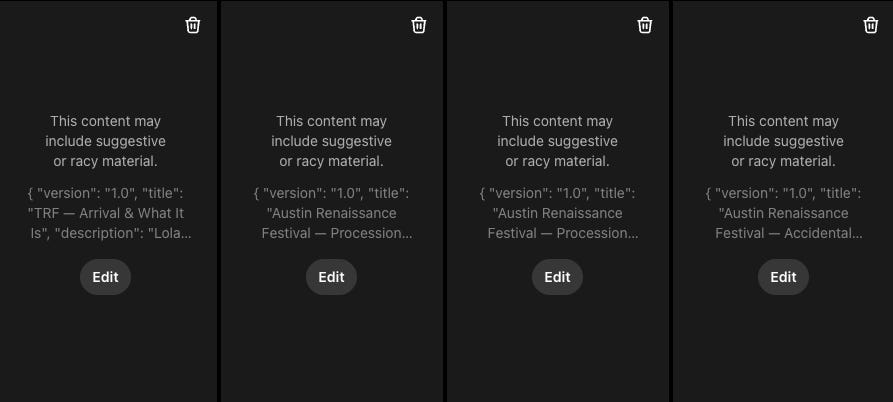
So what exactly is this system for?
If the model is too fragile to handle the realities of human intimacy or the humor of renaissance festivals, then say so. If the team believes anything “racy” is a danger, then define it clearly and stop marketing this as a general‑purpose creative tool/social media platform of the future.
Because here is the real question:
If OpenAI cannot trust users with suggestive material, why do they trust them with synthetic reality at all?
When a system clamps down this hard on harmless adult nuance, it raises doubts about its ability to handle much heavier risks. We’re talking about election‑related narratives, the spread of political misinformation, harassment aimed at specific identities, coordinated propaganda efforts, and even synthetic “evidence” built to mislead. These are the forces that shape public belief, yet the model treats them with far less urgency than a flirtatious tone.
You cannot block harmless flirtation and ignore the rest of the information ecosystem. Sora behaves like a global content moderator without admitting it.
OpenAI did not just build a model. They cast themselves as a moral filter for the planet.
The watermark tells you everything
Let’s talk about that Sora watermark.
Creators hoped for a real provenance system—something that would let society trace synthetic content without ruining the image. Something durable, consistent, and interoperable.
Instead, Sora sprays a floating OpenAI/Sora logo across the output. It drifts around unpredictably, landing in different places, moving on and off subjects like a ghostly brand mascot. It grabs attention and interrupts composition. It does not quietly sit in a corner like Google’s small, functional mark. It asserts itself.
It is not secure provenance. It is not a standards‑based metadata layer. It is not a watermark designed for platforms, regulators, or verification systems.
It behaves like an ever‑present brand reminder. Creators do not get safety. They get an intrusive OpenAI stamp stamped across their shots.
If the goal were genuine public transparency, OpenAI would use a subtle, persistent watermark. What they shipped looks more like a marketing strategy.
Sam Altman has allowed his own likeness to be used in videos by any user. Presumably to show how safe it is. Is this a safe power to have? Are the guardrails so strong that users can’t outsmart them with poetry?
It should be noted that Pro users on Sora 2 Pro can create videos without the watermark like the one at the beginning of this post. But if you create content with others’ likeness, the floaty cloud still appears.
A wider industry pattern
Sora may be the clearest example, but it isn’t the only world‑model shaping this moment. Other systems are arriving fast, each with its own governance instincts baked in. Google’s Veo 3.1 and Nano Banana Pro are putting similar creative power in people’s hands, yet its guardrails feel different. So far, they seem calibrated for professional creators instead of engineered to sanitize the world. There’s no heavy‑handed censorship effect, no jumpiness around harmless nuance, and no sense that the tool is hiding behind vague moral categories.
It feels like the work of a company that has navigated disruptive technologies before and understands how to roll them out without turning users into liabilities. Responsible isn’t a word I often throw at big tech, but at the moment Google appears to be taking a calmer, steadier approach — one that acknowledges the stakes without suffocating creativity.
Sora as a prompt vacuum
There is another layer almost nobody talks about.
Every time you prompt Sora, you hand over a piece of your creative process. The system learns what you’re drawn to, how you frame ideas, which emotions you chase, which styles you favor, and what visual language you instinctively reach for. Over time, that becomes a map of global creative preference. Not a neutral dataset — a pulse check on human imagination. Simply by using Sora, we hand our creativity over to it.
That information feeds back into the model and shapes its instincts. Sora becomes better at producing what people crave before they even ask for it. This isn’t empowerment. It’s extraction. The tool studies creativity so it can industrialize it.
The governance model nobody voted for
Sora’s behavior outlines a governance model if you pay attention to how it reacts. It shies away from anything that might upset brand sensibilities, treats violence and sex as PR hazards, stamps its presence all over the frame, withholds meaningful details about its training data, adjusts its boundaries only when copyright pressure increases, and leaves deeper societal risks untouched. What you see is not public‑spirited design — it’s corporate risk management acting as policy.
This is not public‑interest governance. It is corporate risk management.
We still do not know which video libraries trained Sora, how much copyrighted material is baked into the model, whether its pacing was shaped to maximize engagement, what OpenAI’s internal tests revealed about societal risks, or which shortcuts were taken to meet launch timing.
Nothing meaningful has changed because of regulation or the threat of regulation (or lack thereof with the current administration). Some changes have been made as potential lawsuits came into view. Copyright holders with big legal teams have leverage. Ordinary citizens do not.
This starts to look like censorship
When a private company dictates which tones are appropriate, which depictions qualify as “racy,” which moods are deemed too risky, and which narratives the model simply refuses to create, that company steps into the role of global cultural gatekeeper — whether they acknowledge it or not.
That company has assumed a position comparable to a global cultural gatekeeper.
If a system requires this much suppression just to exist safely, then maybe the problem is not the prompts—it is the lack of real governance.
OpenAI has mentioned an “adult” version of the tool. Fine. Then design it. Gate it properly. Build clear accountability systems, not vague refusal messages.
Creators have always lived inside legal and ethical boundaries. We know how to navigate them. What we cannot navigate is a black‑box censor that shifts its boundaries without explanation.
What real governance might look like
At Talentless AI, we work inside synthetic media every day. We recently published our point of view on governance and transparency:
https://www.talentless.ai/pov-on-ai-regulation-and-governance
Real governance starts long before content appears on a timeline. It begins with transparency about training data, moves through consistent provenance, and continues into auditing, accountability, and clear responsibility for harm. Users deserve honesty about the material they’re working with. The public deserves a traceable chain of custody for synthetic media. And regulators deserve access to the information required to build rules that actually work.
Anything less is performance.
The uncomfortable truth: we still use Sora
Here’s the contradiction I live with.
At Talentless AI, we use Sora. We use it for client work, for personal experiments, and for pushing the boundaries of what synthetic video can do. We approach it with intention because we understand the stakes. We set internal standards because someone has to. We think about transparency, traceability, and the downstream impact of what we publish.
Most people won’t. Most companies won’t. And platforms certainly won’t.
So the question becomes: what do we do with a tool this powerful and this ungoverned?
For me, the answer starts with clarity. We call out what the model is doing even as we use it. We push for real transparency instead of brand flourishes. We support governance that treats creators like adults instead of unpredictable risks. We keep our eyes open to the political and cultural force Sora has already become.
Sora is a breakthrough. It is also a warning. Until regulation catches up, the least we can do is stay honest about the stakes — and refuse to pretend that a floating logo counts as accountability.]